Sunday, 13 October 2013

See the HTC One Max in all its gigantic glory

htc one max
The number of times we’ve seen the HTC One Max leak, you’d almost be forgiven to assume that the manufacturer’s CEO, Peter Chou, is the one putting them out. In the latest round of images (and by far the most detailed) we get to see virtually every nook and cranny of the 5.9″ phablet.
The fingerprint sensor at the back understandably garners most of the attention, with the rest of the device nearly identical to the normal-sized sibling (barring the power button, which is on the right with the volume buttons). The Beats logo is gone too, after the two companies ended their partnership withHTC selling back their stake. Since the screen isn’t turned on, the device could very well be a dummy unit. However, the announcement shouldn’t be too far off, and we should know all the details sometime this week.

htc one max back

HTC One Max side

Nexus 5 leaked in 7-minute hands-on video

We interrupt your regularly scheduled broadcast to bring you breaking news. Our “ Nexus 5 Watch 2013″ continues with a new video of the device that has just been leaked on YouTube. The 7-minute hands-on video is brought to us by the fellas at “smartphones.sfr.fr”, and gives us our best look yet at the Nexus 5 and Android 4.4 Key Lime Pie (KitKat).
It’s pretty obvious the phone shown off in the video is simply an early prototype, as highlighted by the fact that the actual Nexus branding is absent from the device’s back cover. We’re going to continue analyzing the video but in the meantime, if you notice anything noteworthy, shout it out in the comments. Have a great weekend.

Friday, 11 October 2013

10 Awesome Innovations From Google

Bangalore: Google turned 15 this year and has come a long way in terms of innovative products and ideas. From the ultra-modern Google Glass to auto-driven cars, Google’s persistent zeal to achieve quality innovation in variety of fields never seizes to amaze us. As compiled by TOI, here are 10 awesome innovations from Google to celebrate the company’s 15 years of awesomeness.


#10 Password alternatives
Over the last few years, Google has improved its efforts to kill passwords forever. Announcing its support to Fast Identity Online Alliance (FIDO), the company is working on novel means to verify user’s identity when they access their online accounts. Motorola is mixing science with health and is exploring the application of Proteus Digital Health pill, which is has a unique ECG trace that can be used to identify users via external devices. Dennis Woodside, CEO of Google’s Motorola unit also spoke about flexible electronic circuits that can be used as unique passwords by embedding them into people’s skin.
#9 Smartwatch
To compete with other electronics company manufacturers, Google is also stepping up the game by exploring its potential in designing Smartwatches as it recently acquired WIMM Labs, an expert in wearable technology. Google Smartwatch is expected to launch in 2014 and its applications are said to resemble Google Glass. Reports say that Google has unveiled the Smartwatch at three Google meetings held at Mountainview, Manchester and Berlin and global unveiling of this innovative gadget is yet to be seen.


#8 Google Glass
Google Glass is a real-time product right out of a science fiction story. In 2012, Google unveiled its first wearable device that comes with many features. The gadget can be used as an extension of Android Smartphones and tablets and is used to capture photos and videos from a wearer’s perception. It also supports phone calls, and user can check out maps, read emails and text messages and perform various other tasks via voice commands.
#7 Google Fiber
Google Fiber is an internet service which was launched in 2011 and provides a data packet speed of 1GB per second. This service was first rolled out in Kansas and then to Missouri, Texas and Utah in the U.S. Google Fiber comes out in different variants. The basic version costs $70 and has 1TB cloud storage while the subscription with TV service offers 1TB data on Google drive, 2TB digital recording and a free Nexus 7 tablet. There is also a free internet offer which the company provides where users get 5Mbps speed but costs about $25 for annual subscription.


#6 Google Street View
In 2007, Google started the Street View project and over the years, the project has been intercepted with several innovative features that set it apart from its competitors. Google street view option comes along with Google maps, and when selected it provides a panoramic, 360 degree street view imagery of various places around the world. Street view also comes in a 3D version. Using street view, users can see the photos from around the world right from their desktops, mobile devices and also can access it on Nintendo Wii U.
#5 Moto X’s voice recognition
Google’s Motorola division came up with Moto X Smartphone that consists of X8 mobile chip which helps give an enhanced user experience. This chipset is made up of a 1.7GHz dual-core CPU and a quad-core Adreno GPU. The thing that sets this chip apart is its natural language processor, which enables the phone to understand what the user means and contextual awareness processor, which helps the device to know when to turn itself to silent more or which app to open when the phone is held in a certain way. This makes the Moto X to be always alert and even when it’s sleeping if a user gives a voice command like “Okay Google”; the phone wakes up and performs the task.


#4 Google driverless cars
The automobile world is said be greeted by the next big thing in the form of Driverless cars, Google’s proud innovative venture. This started as an idea from Google’s X Lab and these driverless cars are currently being tested by the company in Nevada, Florida and California in the U.S. These cars are still in testing phase and there are no plans yet to commercialize them but reports say that Google may soon roll out unmanned Robo-Taxi to ferry people.
#3 Chromebooks
The internet company has set its foot in the electronic world yet again with laptops called Chromebooks. These laptops are meant for the ‘connected generation’ and runs on Goolge’s Chrome OS and does not support any applications made for Windows and Mac operating systems. Chromebooks have a built-in media player and internet browser. The price for Chromebooks starts at $250, which is cheaper than most tablets and laptops.


#2 Internet balloons
Google recently launched its Project Loon, where it sent out air balloons strapped with internet antennas into the stratosphere at a height of 20km. This project was launched to connect the developing countries where internet connection is weak or almost nil. Through this, Google aims to provide 3G speed via internet balloons which covers an area of 1,256 sq m each.

#1 Android
Google has left its mark in the Smartphone world as 80 percent of the Smartphones today are powered by the company’s Android Operating System. Even though Android is not an original product of Google as it acquired the company that made the OS, Google treated the OS as its own by adding its innovative touch to the software. Initially Android was meant to serve as an OS for digital cameras, but Google turned it into mobile software much before Apple came out with its iPhone.
Today, Android OS with its various versions that are named after a dessert or sweetener, is one of the most popular softwares to be used because of its easy interface, wide range of free apps and its open source nature that gives users option to update their Android versions on their devices for free. Because of this, Android is popularly adopted as OS on mobile devices from companies like Samsung, Huawei, ZTE, Micromax and Xiaomi.

10 Countries That Tweet Most

Bangalore: Twitter is gearing up to go public with its most anticipated IPO event in November. The company is on high hopes to regain the losses it incurred over the past three years by focusing on wooing investors for its revenue growth. According to Reuters, Twitter is expected to seek a valuation of $10billion, which will very well cover the $69 million loss it incurred during the previous year.
As compiled by Rediff, let’s take a look at Twitter’s biggest markets in terms of the countries having the biggest Twitter users.


#1 Turkey
Twitter penetration rate: 31.1 percent


In a recent event, Turkish Government banned its citizens from accessing Social Media like Facebook and Twitter via internet following an angry protest from its people. A majority of the internet users from Turkish then switched to VPNs (Virtual Private Networks) to evade the government’s censorship. With an Internet population of 36,455,000, Turkey has the highest number of Twitter users in the world with a Twitter penetration rate of 31.1 percent. Its estimated percentage of overall Twitter users is about 6 percent. It’s no wonder why Turkey takes the first rank in Twitter usage, all thanks to its persistent citizens.

#2 Japan
Twitter penetration rate: 29.7 percent


Japan is one of the most technologically advanced countries in the world.  That being said, the people of Japan, especially the youth are getting over addicted to the Internet usage; so much so that the Japanese Ministry of Education has asked the government to fund “Internet fasting” camps, where kids will be cut off from computers. Japan has an internet population of 101,228,736 of which an estimated 30,064,935 are Twitter users. Thus with about 30 percent penetration it stands second in the Twitter race.


#3 Netherlands
Twitter penetration rate: 29.1 percent


Netherlands is the 4th leading country in the Global Information Technology amongst the other 144 countries. It has the world’s fastest internet speed and has an internet population of 15,071,191 of which 4,385,717 are estimated to be Twitter users. Thus it ranks third in the overall percentage of Twitter users.
#4 Venezuela
Twitter penetration rate: 28.2 percent


Venezuela Government’s initiation to provide free internet access to its citizens has majorly helped the country to come up in terms of internet technology. A recent study in 2012 revealed that the country had 62 percent increase of internet users within a span of one year since the government’s initiation. Today, 2 percent of the 10,976,342 Internet users from Venezuela are on Twitter. Thus it ranks fourth with an overall Twitter penetration of 28.2 percent.


#5 Philippines
Twitter penetration rate: 25.6 percent


71 percent of the internet users from Philippines are aged between 15 and 35 says the ComScore report, making Philippines one of the leading countries to have a steady growth in Internet Technology. Philippines ranks fifth with 25.6 percent Twitter penetration. With 33,600,000 Internet users, the country has an estimated 8,601,600 users which accounts to 5 percent of the overall Twitter users. The country has the second highest Facebook penetration in the world at 92.2 percent.
#6 The United Kingdom
Twitter penetration rate: 24.2 percent


Information Technology is a huge driver for growth in the U.K in terms of emerging industries, Businesses and entrepreneurship. Out of 52,731,209 internet users, U.K has an estimated 12,760,953 Twitter users and takes the sixth position by having 7 percent of the overall Twitter users.


#7 Indonesia
Twitter penetration rate: 23.4 percent


Even though Internet communication media is relatively new to the many islands of Indonesia, it doesn’t stop its people from picking up fast on the Internet trend. Indonesia has nearly 13,000,000 users of Twitter with a penetration of 23.4 percent and it has seven percent of the overall Twitter users, giving the country seventh position in the Twitter race.


#8 Canada
Twitter penetration rate: 23 percent


With the current growth in the IT sector, Canada is a promising land for many IT companies and professionals. With a total of 27,757,540 internet users and estimated 6,384,234 actively use Twitter. Thus, Canada takes the eighth spot by having 4 percent of the overall twitter users and a Twitter penetration rate of 23 percent.
#9 Colombia
Twitter penetration rate: 20.1 per cent


Columbian government has sanctioned funds to provide broadband connection all over Columbia. The government also has helped set up several Live digital centres across the country which gives free internet access for people to use. Thus, Colombia has more than 5,000,000 Twitter users across the country, with an estimated 3 percent of the overall twitter users and takes the 9th spot in the Twitter race.


#10 The United States
Twitter penetration rate: 19.4 per cent


The United States of America is where the Silicon Valley first emerged, bringing with it technological advancements in various fields and new-age career prospects for millions of people around the world. Technology giants like Google, Facebook and Twitter were started on this very land. Twitter has about 19.4 percent Twitter penetration, even though U.S.A is the home for its headquarters. Thus, with 245,203,319 Internet users, only 27 percent of the population uses Twitter and hence it takes the 10th place in the Twitter race.

Thursday, 10 October 2013

Google's $50 microsuede Nexus 7 cases arrive in four colors

Google's gets four new smart cases for its 2013 Nexus 7, but at $50 a pop they're pricey compared with the $229 tablet and cases made by rivals.

Nexus 7 owners looking to protect their tablet now have four new cases from Google.
Introduced Tuesday on its Play Store, Google's $49.99 cases for the 2013 Nexus 7 model come in black, white or gray -- with colored accents. And similar to Apple's Smart Covers and Amazon's new Kindle Fire HDX cases, the covers can contort to function as stands that prop up the tablet in one of two positions:
Google's Nexus 7 debuted back in July, and was the first device to run with Android 4.3 Jelly Bean. Considering the entry level price of the tablet starts at $229, $50 is on the higher end of what most first-party cases cost, but where Google could make higher margins on what's historically been a very low-margin product.
Google says all four of the new cases ship in one day, and work with both the Wi-Fi and Wi-Fi + cellular models.

Google Nexus 7 (summer 2013) review:

The best small tablet gets even better


The good: The Nexus 7’s razor-sharp full-HD screen, silky smooth performance, long battery life, meager weight, and affordable price make it the best tablet value on the market.
The bad: The back is missing the soft grippy texture of the original, screen colors lack accuracy, and there's no microSD support. Android 4.3 has few useful interface improvements.
The bottom line: Thanks to its stellar performance and affordable price, the Nexus 7 is the Android tablet to get.

Nexus 5 16GB version reportedly will sell for $299

If true, that's $50 less than the price tag on a 16GB Nexus 4.


LG's new Nexus 5 may launch with a price tag of $299.
A tip received by blog site Phone Arena claims the 16GB Nexus 5 will sell for $299 and the 32GB version for $399. Further, the tipster said the 16GB edition will come with a 2300mAh cell battery, while the 32GB model will be equipped with a 3000mAh cell battery.
In contrast, the Nexus 4 costs $299 for 8GB and $349 for 16GB. Both Nexus 4 models offer a 2100mAh cell battery.
The tip comes from an anonymous source and so should be taken with a grain of salt. But the information sounds credible, as LG likely would want to bump up the storage options for the next unlocked Nexus yet keep the pricing in line.
A "source familiar with Google" recently told TechRadar that the Nexus 5 would cost "half the price" of the iPhone 5S, which puts the smartphone at a slightly higher price point. The 5S sells unlocked for $649, giving the Nexus a price tag of around $324. An alleged copy of a Nexus 5 service manual, which has since been removed at LG's request, revealed many of the phone's key specs.

Nexus 5: What we expect about the announcement, specs, and release date of Google's next smartphone

The Nexus 5 is expected to debut with Android 4.4 KitKat by the end of October.
Don't look now, but the LG Nexus 4 successor is expected to make its formal debut by the end of this month.
Rumors and conjecture have been floating around for much of the summer, and now details seem to be falling into place quickly for the updated flagship Android smartphone.
Even though Google hasn't made anything official quite yet (not even the launch event date), there's certainly quite a bit we already think we know about the next Nexus. Here's what's expected and what still remains uncertain.

What we expect

October reveal date
We're still waiting for Google to send out invitations, but multiple sources point to an October unveiling for the Nexus 5. According to a TechRadar report, Google will announce and ship the phone in the last week of the month. Other sources, while not quite as specific, have also mentioned an October introduction.
This fits into Google's pattern as well. Last year's Nexus upgrade was also scheduled for the early autumn time frame, before Hurricane Sandy's interference pushed back the date.
Android 4.4 KitKat
The Nexus 5 should be the first smartphone to run Android 4.4 KitKat, Google's next OS iteration, out of the box. Google has already formalized the platform, but the details are a complete mystery. The fall time frame falls in line with previous platform releases; Android 4.0 came in October 2011, and Android 4.2 showed up in November 2012.
LG will make it
All signs point to Google again calling upon LG as the hardware maker of choice for the Nexus smartphone line. Documents found in the FCC tell of a model called LG D820 with specifications not entirely unlike the G2's, which is the source we expect the Nexus 5 to stem from.
Biggest Nexus yet
The Nexus 5 should have a 4.96-inch screen, which would make it the largest Nexus smartphone to date. We should look for the same 1,920x1,080-pixel HD display as the G2's, which equals a 444-pixel density.

Body shape
Thus far, leaked images suggest that the Nexus 5 will maintain a form factor that doesn't stray far from the LG Nexus 4's. Early photos of the device, however, do not show the same design flourish or patterns on the rear.
Hardware
The Nexus 5 should be able to hold its own against the competition thanks to the quad-core 2.3GHz Snapdragon 800 CPU. Bolstered by 2GB of RAM, LTE support, and NFC capability, the handset is expected to employ wireless charging capability and a 2,300mAh battery. Leaked benchmarks results have the Nexus 5 outperforming all other Android devices and rivalingApple's iPhone 5S.
A 16GB Nexus 5 could sell for $299 and include a 2,300mAh battery, while a 32GB model could come equipped with a 3,000mAh cell battery and retail for $399. Additional storage via microSD is atypical of Nexus smartphones; a recently leaked manual made no reference of the external slot.
Carrier support
FCC documents indicate that the Nexus 5 is equipped for penta-band HSPA+ and multiple LTE bands and should support all four major carriers in the US: Verizon, AT&T, T-Mobile, and Sprint. This could mark the first time that Google is able to offer one device across all top-tier carriers.

Lingering questions

For all that we think we know, there are a few details that need clearing up.
The name
Given that Google pulled the old switcheroo on us with Android 4.4 KitKat (which had previously been confirmed as Key Lime Pie), we shouldn't rule out a name change for the upcoming smartphone. It does mark the fifth-generation Nexus handset, and it should have a 5-inch display. With that said, we should still keep our guard up for a last-minute audible. Nexus G, anyone?
Camera technology
If the Nexus 5 is based on LG's G2 smartphone, then we may see the optical image stabilization (OIS) technology found in the camera. Google likes to introduce new camera features with Android releases, and OIS could make for a compelling user experience.
Price
As one of the most important questions for any device, the cost of the Nexus 5 still remains unclear. Historically, Google has offered its Nexus models unlocked with an attractive price point that falls below much of the competition. There is no indication yet that Google would go in a different direction for the new flagship, though pricing is an important question for contract carriers.
Sales model
If history is an indicator, Google will sell the Nexus 5 two ways. One is via the Google Play store, where customers can buy the phone unlocked or choose a wireless provider. The other will likely be through the carriers themselves, as with the Nexus 4 on T-Mobile. This time around, it's more likely that we'll see the top-tier carriers sell the device at the outset, rather than as a limited exclusive.

Tuesday, 8 October 2013

Edgertronic Affordable High-Speed Camera Will Officially Be Released

With backers pledging more than $70,000 past the original goal, there'll soon be a more affordable high-speed camera on the market

High-speed video cameras are not cheap — especially if you want both fast frame rate and decent sized video. But thanks to a very successful Kickstarter campaign, Edgertronic could create a new generation of speedy, (relatively) affordable video cameras capable of capturing web video at 2,000fps.
Let's face it, a Phantom camera is out of the budget for most people. But the Edgertronic is promising a high-speed camera for $5,000, a fraction of some of the other options on the market. And obviously people are on board with this idea, as the Kickstarter raised more than $170,000, despite needing just $97,900.
On a technical side, what's interesting is that the Edgertronic uses a comparatively large sensor, but with a low resolution. It uses a 18x14mm CMOS sensor (that's around the same size as a Four Thirds type), but with a resolution of just 1280x1024. But while that means the video size is small, it means that each pixel is a large 14 microns, which should mean better quality.
If you run the Edgertronic at full resolution, you'll be limited to 494fps, but that bumps to 700 at 1280x720; nearly 2,000fps at 640x480; and all the way up to 17,791fps at 192x96.
The Edgertronic will also use a Nikon F mount, which means there are an awful lot of lenses that will already work with it. If you're interested in more of the technical side of the device, this piece by Tested does a good job of explaining it.
There have been other attempts to make high-speed video more affordable. Casio is perhaps the most famous, who in 2008 debuted the EX-F1, which could capture a sliver of video at 1200fps, but with a $999 pricetag. The company has still produced high speed cameras like that recently, but the technology has slightly fallen by the wayside — and it was never at as high a resolution as the Edgertronic is promising.
Initial estimates peg the Edgertronic as shipping this December, so backers should get their hands on them in the very near future. 
It will be interesting to see how something like this fends off other big manufacturers in the future. The GoPro HD Hero3+ can do WVGA video at 240 FPS, while even the iPhone 5s is bumping its capture up to 120 fps. The future will be interesting. And slow.

Terraria now available on Android

Sandbox adventure game Terraria has been launched for Android devices. The game includes extra exclusives including an Android robot, as well as Facebook-integrated Game Services leaderboards and achievements.

Terraria now available on Android
Publishers 505 games have announced that the sandbox game Terraria will now be available on Android. The trial version of the game can be installed for free from the Google Play store, the full game however, will be available for $4.99, which is around Rs.320 approximately.
The game features a completely revamped interface making it more intuitive for touch-based devices. The game was initially launched on the iOS, however, the Android version will include extras such as an Android robot, integration with Google Play games, including achievements and leader boards along with Facebook integration.
Terraria is an indie adventure game involving fighting, exploring and building your your own house, a fort or even a castle.
The game has been critically acclaimed for its pixel-art graphics and intensive gameplay.
Source: Joystiq

Samsung Galaxy S4 Active LTE-A version with Snapdragon 800 surfaces online

GalaxyS4-Active.jpg
t looks like Samsung is planning to introduce a Snapdragon 800, LTE-Advanced version of the Galaxy S4 Active, the ruggedised (water and dust resistant) version of the company's flagship smartphone, the Galaxy S4.
 
Details of this new iteration of the Galaxy S4 Active were leaked by Korean website DAUM(via - Slashgear), which claims to have spotted documents related to it on Samsung's Korean website.
 
The documents suggest that the Galaxy S4 Active's LTE-Advanced version would also come with IP67 certification being waterproof and rustproof. The new version is said to offer LTE-A connectivity through Qualcomm's processor-integrated LTE antenna, allowing the phone to work with more than one LTE band for faster access. This would imply it would be powered by an advanced version of the Snapdragon 800 chip.

galaxy-s4Active-lte-a.jpgThe other specifications of the phone are the same as that of the original Galaxy S4 Active phone. The Galaxy S4 Active comes with 2GB of RAM and features a 5-inch full HD (1920x1080 pixels resolution) TFT LCD screen that has a pixel density of 443 PPI. It runs Android 4.2.2 Jelly Bean
 
The Samsung Galaxy S4 Active sports an 8-megapixel rear camera with LED flash and a 2-megapixel front facing camera. The phone offers 16GB internal storage in addition to a microSD card slot that allows users to expand storage up to 64GB. It comes with a 2600mAh battery.
 
The Galaxy S4 Active features an accelerometer, proximity sensor, a gyro sensor, digital compass, barometer, gesture sensor, finger hovering sensor and a light sensor. It comes with Wi-Fi a/c (Gigabit), Wi-Fi direct, Bluetooth 4.0, NFC and LTE connectivity options and an Infrared blaster.
 
The phone will reportedly be launched only in South Korea through SK Telecom. It's worth pointing out that SK Telecom is the world's first telecom company to have launched an LTE-A network that is capable of reaching network speeds of up to 150Mbps, up to twice the normal 4G speed. 
 
Samsung had also launched an LTE-Advance version of the Galaxy S4 in South Korea in June.
- See more at: http://gadgets.ndtv.com/mobiles/news/samsung-galaxy-s4-active-lte-a-version-with-snapdragon-800-surfaces-online-429464#sthash.xbloLOtW.dpuf

Leaked Knox document reveals Android 4.4 update for three Samsung Galaxy smartphones

samsung-knox-reveal-big.jpg
A new report has revealed that the Android 4.4 KitKat firmware update for Samsung Galaxy S4 mini, Galaxy Mega 5.8 and Mega 6.3 might be rolled out soon.
Sammobile has obtained an image of the internal document for Samsung's security suite, Knox, that allegedly reveals a list of Galaxy smartphones due to get Android 4.4 KitKat.
The leaked image shows the Samsung Galaxy S4 mini and Galaxy Mega (Mega 5.8 and Mega 6.3) supposed to come preloaded with Knox once the devices are updated to Samsung's Android 4.4 KitKat-based firmware.
Unfortunately, the list does not reveal anything about the possible release date of Android 4.4 KitKat for these smartphones. Earlier it was reported that the Samsung Galaxy S III, Galaxy S4 and Galaxy Note II would be upgraded to Android 4.3 Jelly Bean by year-end. The company was said to be planning an Android 4.3 update for its top of the line smartphones soon.
The site further suggests that Knox will be preloaded on all the devices- Galaxy Note 3, Galaxy Note II, Galaxy S4, Galaxy S4 mini, Galaxy S III, Galaxy S III mini and Galaxy Mega once they receive the respective firmware updates as listed in the leaked image of Knox security suite.
The report further suggested that the Galaxy Note II, Galaxy S4 and S III would also be getting the taste of the new Jelly Bean iteration, but that would only be by the end of November, or early December. All three smartphones are also likely to receive a revamped TouchWiz interface with some added functions, claimed the report.

Nokia Lumia 1020: First Impressions

nokia-lumia-1020-procamapp.jpg
The Nokia Lumia 1020 is one of Nokia's path breaking products. The company has been focusing on innovation in imaging technology, and the first smartphone to showcase it was the Nokia PureView 808, which was based on the ageing Symbian platform. Nokia decided to abandon Symbian and switch to Windows Phone but it took the company some time to bring the PureView technology to the new platform, despite using the PureView branding with some of the early Lumia Windows Phone-powered devices to highlight their special camera features which included low-light imaging and optical image stabilisation.
 
The Lumia 1020 is the first Windows Phone smartphone to bring the PureView 808's oversampling technology with its 41-megapixel rear camera. It also includes a Xenon flash which was last seen in the 808. The phone was launched with much fanfare in New York, in July and after almost two months, Nokia has brought the Lumia 1020 to India.
 
We were able to spend some time with the phone during the launch event and here are our first impressions.
 
The Nokia Lumia 1020 looks strikingly similar to the Lumia 920 at first glance. The Lumia 1020 features the similar unibody design and a polycarbonate shell as the Lumia 920.The two sport very similar dimensions, with the Lumia 1020 slightly thinner (at 10.4mm, compared to 10.7mm), and quite a bit lighter (158 grams, compared to 185 grams).
 
The front of the Lumia 1020 is dominated by a 4.5-inch AMOLED display which features Corning Gorilla Glass 3 protection and Nokia's ClearBack and PureMotion HD+ technology. The display looks crisp and bright with colours appearing to be really vivid. It's worth pointing out that the screen sports a resolution of 768x1280 pixels and pixel density of 334ppi.

nokia-lumia-1020-front.jpgThe right side of the Lumia 1020 features three hardware buttons, namely the volume rocker key, the power/screen-lock key and the camera shutter key, all made of plastic. The keys are black in colour, and offer good tactile feedback.
 
The bottom of the Lumia 1020 features the Micro-USB port and a speaker-grill, while the top houses the 3.5mm headset jack, and the micro-SIM card slot. There are no ports or buttons on the left hand side of the phone.
 
With the Lumia 1020, Nokia proudly proclaims that the 'rear is the new front,' and that clearly shows on the device. The phone's rear sports a big camera lens at the back that protrudes out. It might feel a bit awkward but we have to keep in mind that this is a camera-focused smartphone. In fact, the camera is the star.

 The camera ring is black in colour and features a mechanical shutter, a Xenon flash and an LED light for videos and auto focus assist. After spending some time with it, we have to say that the camera hump on the back is not very obstructing and the phone can be easily carried in a pocket.

nokia-lumia-1020-camera.jpg The Lumia 1020 runs Windows Phone 8's Amber build. It features double tap to unlock, FM radio and other features in addition to standard Windows Phone 8 goodies. The phone also offers the Nokia Pro Camera app which has been created specifically for it. The app allows users to tinker with all camera settings just like professional cameras leveraging the power of Lumia 1020's 41-megapixel lens. At the same time, it makes easy for amateurs to take great pictures. We did notice some lag while clicking pictures.
 
Nokia has announced that the phone will be available starting October 11 and it will announce the pricing a day prior to it. We'll have a detailed review as soon as we get a review unit.

Google Gem smartwatch to launch on October 31: Rumour

google-neon-logo-635.jpg

Smartwatches are the latest fad in the world of gadgets, and Google has been rumoured to be working on its own smartwatch for quite some time now. While there's been no official word on the existence of the watch, leave alone a launch date, a new rumour predicts an October 31 launch for a Google Nexus watch, codenamed Gem.
 
According to Artem Russakovskii of Android Police, Google could announce the Gem smartwatch together with Android 4.4 KitKat, when it also expected to launch the successor of the Nexus 4 smartphone. Russakovskii clarifies that the date was leaked about a month back so there could have been some changes in the Mountain View giant's plans.
 
Earlier this year, Android-focused website, Android Authority, had said that the watch was ready for release after it was last demoed at Google's Mountain View campus after being showcased at its Berlin and Manchester offices.
 
The web publication cited sources to inform that the smartwatch would be made by Motorola and that its functionality would be similar to Google Glass with an interface that resembled Google Now's cards. It had also said that the watch will need to be tethered to a smartphone and that the apps meant for the watch were being dogfooded or being internally tested.
 
In March, it was reported that Google was indeed working on a smartwatch. The report had indicated that the watch was beyond the prototype stage. It had also mentioned that Google had filed a patent application for a "smart watch" in 2011. According to the patent, the smart watch sports a dual-screened display and has an interactive user interface. It will be interesting to see if these things will be incorporated in the final product.
 
Device makers like Samsung and Sony have already launched their new smartwatches in anticipation of Apple's much talked about counterpart, iWatch. 
 
Chipmaker Qualcomm also recently unveiled the Toq, a smartwatch that can play music and handle phone calls and messages, and said it would start selling the device in the fourth quarter, marking an entry into the emerging arena of wearable computing. 
 
Competition in the "smartwatch" market is heating up, with Microsoft also reportedly racing to develop its own watch-type wearable computing devices.  

Nexus 5's battery, pricing and storage details leaked ahead of launch

nexus-5-leak-123-big.jpg

While we still wait for the official announcement of alleged Nexus 5 tipped for October 31, the device's price has now reportedly been revealed.
The pricing comes courtesy Phonearena, which cites a tipster claiming that the long-rumoured Nexus 5 will come in two storage variants. The 16GB Nexus 5 will supposedly be priced at $299 (Rs. 18,500 approximately), while the 32GB Nexus 5 is expected to be priced at $399 (Rs. 24,500 approximately).
Additionally the site claims that the next Nexus smartphone would come in two different battery sizes for 16GB and 32GB storage models. As per the report, the 16GB is said to include a 2300mAh battery while the 32GB model would pack a 3000mAh battery.
We had already reported that the alleged Nexus 5 will come in 16GB and 32GB storage onboard, as the company has shifted to larger inbuilt storage on the device.
Looking back, we note the Nexus 4 was released for $299 for the 8GB variant (unlocked) and the 16GB variant was available for $399. However, both the Nexus 4 models shipped with the 2100mAh battery.
Both the search engine giant, and the South Korean handset maker thought to be once again making the next Nexus smartphone, have been tight-lipped about the device's arrival. However, plenty of leaks have revealed much of the Nexus 5, ahead of its launch.
The latest leaks indicate the Nexus 5 will come with a 4.95-inch full-HD (1080p) IPS LCD display, Qualcomm Snapdragon 800 quad-core processor clocked at 2.3GHz, 2GB of RAM, 8-megapixel rear camera with OIS and a 1.3-megapixel front-facing camera. The alleged Nexus 4 successor is also rumoured to include a host of sensors like ambient light, proximity, pressure as well as accelerometer, compass, notification LED and gyroscope.
Prior to this, a report suggested the successor to the Nexus 4 would be unveiled later this month, while it would start shipping in the last week of this month.
It is rumoured that the next Nexus smartphone would run Android 4.4 KitKat, and that the smartphone would be the platform lead device for the operating system, with both due to be launched at the same event.

Monday, 7 October 2013

Tech quiz by Androidisco

                                               Androidisco Presents 
                                            Tech Quiz
             Show your Knowledge,Share your Knowledge


                                                 Follow us on Google+ page Androidisco
                              Daily questions will be posted on Google+ page and Answers here

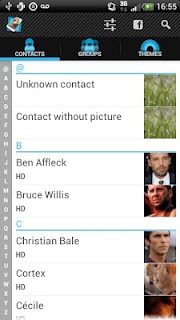
Full Screen Caller ID PRO


Version 9.6

Downlaod Links


Screenshots


Description
This is the original Android Full Screen Caller ID with more than 2 Millions downloads and 50.000+ paid installations ! Thanks all for your awesome support !!
The Full Screen Caller ID is a replacement caller screen for your Android Device.
Using this program you can customize the way your phone notifies you upon incoming & outgoing calls, sms, emails and missed calls.
--== Basic features ==--
- Full screen notification for incoming calls
- Full screen notification for outgoing calls
- Full screen notification for missed calls
- Full screen notification for incoming SMS
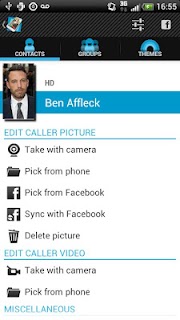
- Assign picture to groups of contacts (family, coworkers...)
- All buttons and texts are customizable
- Use pictures from sd card, internal camera, online gallery or facebook
- Customize caller design : pick colors, text size of the notifications
- Text-to-speech : the full screen caller id can read out loud your incoming calls, sms and mails
- Facebook integration : pick pictures from facebook or link your contacts with your facebook friends to update all profil pictures with one click
--== Advanced features ==--
- Android integration : share pictures from any Android application to set pictures for your contacts
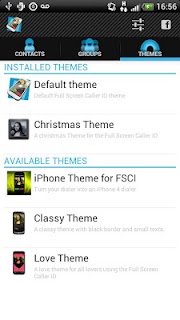
- Theme support
- Answer by buttons : no more slider to move to pick up the phone
- Answer by sliding the screen.
- Landscape support : high resolutions pictures can be set for both portrait and landscape mode.
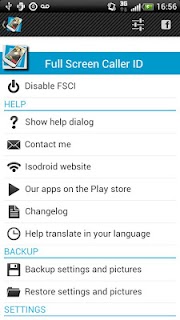
- Backup and restore all settings and pictures.
- Video caller Id (beta)
- Block annoying contacts
--== How to use ==--
Please check the youtube video to learn how to use the software.
Full Screen Caller ID will work instantly once installed but you have to assign HD pictures to your contacts to avoid full screen blurry pictures. HD pictures must be assigned from the Full Screen Caller ID menu, not from the stock Android contact application.
--== Know limitations ==--
This limitations are imposed by Google, there is nothing I can do about it.
- no support for double call
- no support for answering when bluetooth headset is plugged on ICS devices
- no dialpad inside FSCI (double tap to close and use stock dialpad)
--== Contact me ==--
Contact me if you have feature request or bug report. When reporting a bug, please describe the problem precisely and write your device reference and android version.
I work alone on this project so I won't be able to answer every single mail. However I read all mails and will fix reported bugs.
Follow me on twitter : http://twitter.com/#!/@ChristopheNys

Downlaod Links

LG Confirms It Will Mass Produce 6-Inch Phone With Curved Flexible lass Display Next Month


LG has today announced that it will begin mass producing a new 6-inch smartphone with a curved glass display next month. It’s unclear when we’ll be able to purchase the device, but LG will surely be launching it to compete with a similar offering from Samsung, which we expect to see later this month.

“LG Electronics Inc’s display unit said on Monday it will start mass production of curved smartphone displays as the South Korean phone maker plans to launch a smartphone with the new screens next month to catch bigger rival Samsung Electronics Co Ltd,” Reuters reports.
The display will measure six inches diagonally and just 0.44mm thick, making it the world’s thinnest smartphone display — but we don’t yet know any other details about the smartphone itself at this time. According to a recent report from The Wall Street Journal, however, it will be called the G Flex, and it will look similar to the device in the sketch above.
Samsung announced its own smartphone with a curved display last month, and it promised the device would be available in October. The South Korean company first showed off the technology at CES back in January, and we’ve been anticipating a Samsung smartphone that utilizes it since then.
One thing you can expect from both devices is high-end specifications and a premium price tag. Curved displays aren’t cheap, and so the smartphones that carry them won’t be, either.

HTC EVO 4G LTE To Receive Android 4.3 Before End Of The Year


On Saturday the President of HTC America, Jason Mackenzie, officially revealed on Twitter that the company’s former flagship smartphone of 2012, the EVO 4G LTE, is scheduled to receive the much-anticipated Android 4.3 and Sense 5 update before the end of 2013. This announcement comes just two days after the Happy Telephone Company started rolling out a rather significant stability upgrade for the handset.
The EVO 4G LTE was released back in May, 2012, and packs a 4.7-inch Super IPS LCD2 capacitive touchscreen, a 1.5GHz dual-core Qualcomm Snapdragon processor, an Adreno 225 GPU, 1GB of RAM, 16GB of internal storage (upgradable up to 32GB via microSD), an 8-megapixel rear-facing camera and a 2,000 mAh non-removable Li-Ion battery.
The full changelog for the Android 4.3 Jelly Bean update can be seen below:

  • Android 4.3 Jelly Bean & HTC Sense 5.0
  • Autocomplete – just start touching numbers or letters and the dial pad will suggest phone numbers or names. To turn on this feature, open your phone app settings and enable “Dial pad autocomplete.”
  • OpenGL ES 3.0 – Android now supports the latest version of the industry standard for high performance graphics.
  • Additional language support – Android is now translated in Africaans, Amharic (አማርኛ), Hindi (हिंदी), Swahili (Kiswahili), and Zulu (IsiZulu).
  • Hebrew, Arabic, and other RTL (right-to-left) – now supported in the home screen, settings, and Phone, People, and Keep apps.
  • Easier text input – an improved algorithm for tap-typing recognition makes text input easier.
  • Lower latency input for gamepad buttons and joysticks.
  • Location detection through Wi-Fi – use Wi-Fi to detect location without turning on Wi-Fi all the time.
  • Bluetooth Smart support.
  • Bluetooth AVRCP 1.3 support – display song names on a car stereo.
  • Disabled apps tab – check which apps are disabled in Settings > Apps.
  • Restricted profiles – put your tablet into a mode with limited access to apps and content.
  • Setup wizard simplification – getting started on Android is easier thanks to the ability to correct previous input, and because of streamlined user agreements.
  • Faster user switching – switching users from the lock screen is now faster.
  • Enhanced photo daydream – navigate through interesting albums.

Microsoft Brings Wordament With Xbox Live Achievements To Android


Wordament, the word game from Microsoft that brought Xbox Live achievements to iOS for the first time back in December 2012, is now available on Android. Players can login with their Xbox gamertag to play the game and earn up to 50G for competing simple tasks, such as playing ten rounds, or finding the longest possible word in a round.
When you open up Wordament for the first time, simply sign in with your Microsoft account and the game will sync your friends and leaderboards, and allow you to play against Xbox Live “frenemies.” It won’t sync your achievements across different platforms, however, which means you can earn points on Android, iOS, and Windows Phone for completing the same tasks.
Don’t worry if you don’t have an Xbox gamertag, though; you can also play Wordament as a guest, or login with your Facebook credentials.
The aim of the game is to find as many words as you can on a board of letters, each of which will earn you a certain number of points. Each round is played online with thousands of players taking part, and those with the highest number of points win. Not only will you want to find as many words as you can, but you’ll also want to make them as long as possible.


Copyright @ 2013 Get Everything.